Neferneferuaten:
Glorious is the Splendour
of the Sun
 By Robin Gordon
 Auksford 2024
©
Copyright
Robin Gordon, 2024
PART V:
NEBKHEPERURE
24.
The funeral of a beloved King
Auksford 2024
©
Copyright
Robin Gordon, 2024
PART V:
NEBKHEPERURE
24.
The funeral of a beloved King
The time had come for the installation of the
King’s
sarcophagus. It was dragged into the Valley of the Kings on a
sledge, slid on ramps down the stairs, but it stuck and some of the
lower steps had to be cut away before it could be brought into the
antechamber.
Ay’s overseers urged the workmen on, but there was
another
crisis. The sarcophagus was too big to fit through the
doorway
into the burial chamber. The overseers, now frantic to avoid
Ay’s rage, screamed at the workmen to hack away part of the
wall,
promising them rewards if it were done quickly and dire punishments if
the delay in the installation delayed the funeral ceremonies.
The doorway was widened and the heavy sarcophagus lowered
into
the burial chamber. It would have been easier with longer
ramps,
but there was not enough room. Still the workman managed it,
and
did so without damaging their beloved King’s
sarcophagus.
It’s cracked lid was then caried into the anteroom and leaned
against the north end of the east wall.
A
message is
taken to Ay, waiting impatiently at Tutankhamun’s funerary
temple, that the tomb is ready. He orders the procession to
start.
The trumpets blare and the soldiers begin a slow march
towards
the Valley. Too slow in Ay’s opinion, but there are
still
several days before Horemheb is expected. The soldiers are
followed by a procession of priests, some carrying the shrine of
Anapau, but the statue of the god is not in the shrine, for it has
already been set up in the treasury to guard the King’s
digestive
organs. Behind the empty shrine comes the Lord Ay, borne in a
carrying chair and holding the adze with which he will perform the
ceremony of the Opening of the Mouth. Behind Ay comes the
linen-wrapped body of the King, lying on the lion-headed embalming
bier, which is drawn by the great officers of state. The
shrine
containing the jars with the King’s organs should come next,
but
it is already in the treasury under the guard of Anapau. It
is
the wrong way round in the tomb, but, though this has been reported to
one of Ay’s overseers, he has ordered that no attempt be made
to
get in and correct its position and neglected to pass on the report to
Ay. Finally come the three great couches, the chariots drawn
by
horses and the many other treasures that will fill the tomb.
There are no Muu-dancers,
and no time is wasted visiting the ritual places. The
procession heads straight to the tomb.
On arrival the officers of state relinquish the sledge, the
King’s body is raised upright, and Ay performs the ceremony
of
the Opening of the Mouth. The King’s body is then
placed in
his solid gold coffin and the funerary mask placed over his
face.
Unguents are then splashed carefully onto his wrappings.
“Faster!” snaps Ay, and one of his men
grabs the
ointment pot from the priest and tips it over the body. The
priests then spread a pall over the King, the craftsmen place the lid
in position and seal it with gold pins that fit into the
tenons.
Strips of course linen are already in place under the gold
coffin. The workmen use them to raise it and lower it into
the
first of the wooden coffins, the one made for the King’s
father,
King Neferkheperure-Waenre-Akhenaten. The linen bands are
then
pulled out, and Ay’s overseers, who have taken over the
unguent
pots, slosh more over the gold coffin and throw in the dried flowers
and fruit brought by the funerary priests from their store of ritual
necessities.
The middle coffin is sealed then lowered into the outer
coffin
using linen strips which are then removed. More unguents are
sloshed in, more dried flowers thrown in, the middle coffin covered
with a fine linen sheet and the outer coffin sealed.
The
outer
coffin has handles. Ropes are attached, then it is hauled
into
the tomb, manhandled across the antechamber, hoisted up ramp to the top
of the sarcophagus and lowered in. The lid of the sarcophagus
is
then carried in from the antechamber and hoisted into
position.
The beautiful yellow quartzite sarcophagus was to have had a domed
quartzite lid, but the one Ay has ordered for use is a flat slab of red
sandstone with a crack. It won’t close over the
feet of the
outer coffin.
“I told the Lord Ay we needed a domed lid,” said
the chief
sculptor, “but he wouldn’t listen.”
“Well, what are you going to do about it?” snarled
one of
Ay’s overseers. “It’s your
responsibility.”
“But …”
“Don’t waste our time,” snapped the
overseer and
turned to the workmen. “Hack the feet of the
coffin,”
he ordered. “Hack off as much as you need to get
the lid to
fit. What are you waiting for? Do you want me to
tell Lord
Ay, the next King, that you refused to carry out his orders?”
The workmen took adzes and hacked the feet off the coffin, then they
hauled the sandstone slab up again and fitted it into place.
“Carpenters, get those shrines set up,” shouted the
overseer, and went outside to report to Ay that the late King was
safely sealed up in his sarcophagus.
The priests and soldiers were dismissed along with the various
courtiers. Ay, the two viziers and five of his closest
allies,
including, of course, General Nakhtmin, sat down to the ritual funeral
meal while inside the tomb the carpenters set about erecting the
shrines.
The carpenters soon discovered a problem. The workmen who had
carried in the walls of the shrines had left the north walls in the
antechamber and leaned the south walls against the north wall of the
burial chamber. The east and west walls were also
reversed.
The doors which should allow the King’s akh to go westward
into
the Afterlife faced east. The overseer of the carpenters
insisted
that this should be reported to Ay and accompanied Ay’s man
to
the feast, where Ay, now in high good humour at the success of his
rapid burial of Tutankhamun, happily explained to the chief carpenter
that, since that late King was the son of the heretic
Neferkheperure-Waenre-Akhenaten, he would accept, like his father, that
his spirit should travel east towards the rising son, that, in any
case, though the doorways of Kings’ shrines led to the west,
they
opened onto solid rock, so it was clear that the spirits of the dead
could travel through anything however solid, and therefore that they
could move in any direction they pleased.
The chief carpenter then expressed a worry that the shrines might not
fit together properly as they had been made to fit closely around the
sarcophagus and were now reversed. Ay’s
good-humoured
patience ended suddenly.
“You will make
them fit together,” he snapped, “and if there is
any further delay
I shall have you whipped
and dismissed.
Do you understand?”
“Yes, my Lord”
“Yes, Your Majesty!”
honked Ay. “Now that that boy is safely
buried, I am King!”
“Yes, Your Majesty,” gabbled the carpenter, bowing
and backing away.
The carpenters found the erection of the shrines a difficult
business. There was very little room to move. The
innermost
shrine was designed to fit closely round the sarcophagus with only an
eighth of an inch to spare. The sarcophagus must have been
just
about that much out of true, so the sides had to be forced
together. Bringing in the fourth wall was difficult, and two
of
the carpenters had to stand on the sarcophagus to haul the roof of the
shrine. The crack suddenly widened and they scrambled off.
The second shrine was even more difficult. The carpenters had
to
bash it to get the parts to join. They grumbled.
They had
created a beautiful piece of work, and now they were obliged to treat
it roughly, to bash it with mallets and damage it in places.
Their chief urged them on. The new King wanted it
done. The
only way to do it perfectly would be to have the whole sarcophagus
removed so that the shrines could be taken out and brought back in in
the right order. That was plainly impossible. The
walls of
the shrines had to be fitted together by force, and no-one would see
the damage. The King, they felt must be protected.
They
could not leave gaps.
The roofs of all the shrines apart from the innermost were in
sections. They could be moved more easily into place, but
even
so, with Ay’s overseers harrying them, one section was put in
the
wrong way round, and the overseers would not let the craftsmen take it
out and turn it around.
As soon as the final shrine was banged into position the overseers
hustled the carpenters out, called in the plasterers and ordered them
to set to work on plastering the walls of the burial chamber.
The
plasterers’ overseer refused.
“It’s getting late,” he said.
“We can’t start now.”
“What difference does it make?” said Ay’s
overseer. “The tomb is dark. You have to
work by
torchlight. Day or night makes no difference.”
The chief plasterer held firm. “My men have been
working
all day,” he said, “and now they need to eat and to
sleep. We’ll start first thing tomorrow
morning.”
“His Majesty, the Lord Ay will not be pleased. He
wants the
plastering and painting done as soon as possible.”
“If you make men work while they are half asleep they will
make
mistakes,” said the chief plasterer, “and then it
will take
longer to put them right than if you had let them rest.
Haven’t you heard the proverb: an overhasty step brings a man
to
a nasty fall?”
The overseer had to agree. The plasterers started work next
morning, and the anteroom had to be left clear for them. The
annexe, however, could be loaded, and Ay’s overseers kept
their
workman hard at it till late evening.
As soon as the plasterers had finished their work Ay’s
overseers
ordered them out and summoned the painters. The overseer of
painters objected that they could not possibly paint on wet plaster, so
there was some further delay, and the plaster was not completely dry
when the painting started. The painters had their
instructions. The decoration of the burial chamber was kept
simple with large-scale pictures that could be finished quickly, and
the most important scene was one they had never before had to include
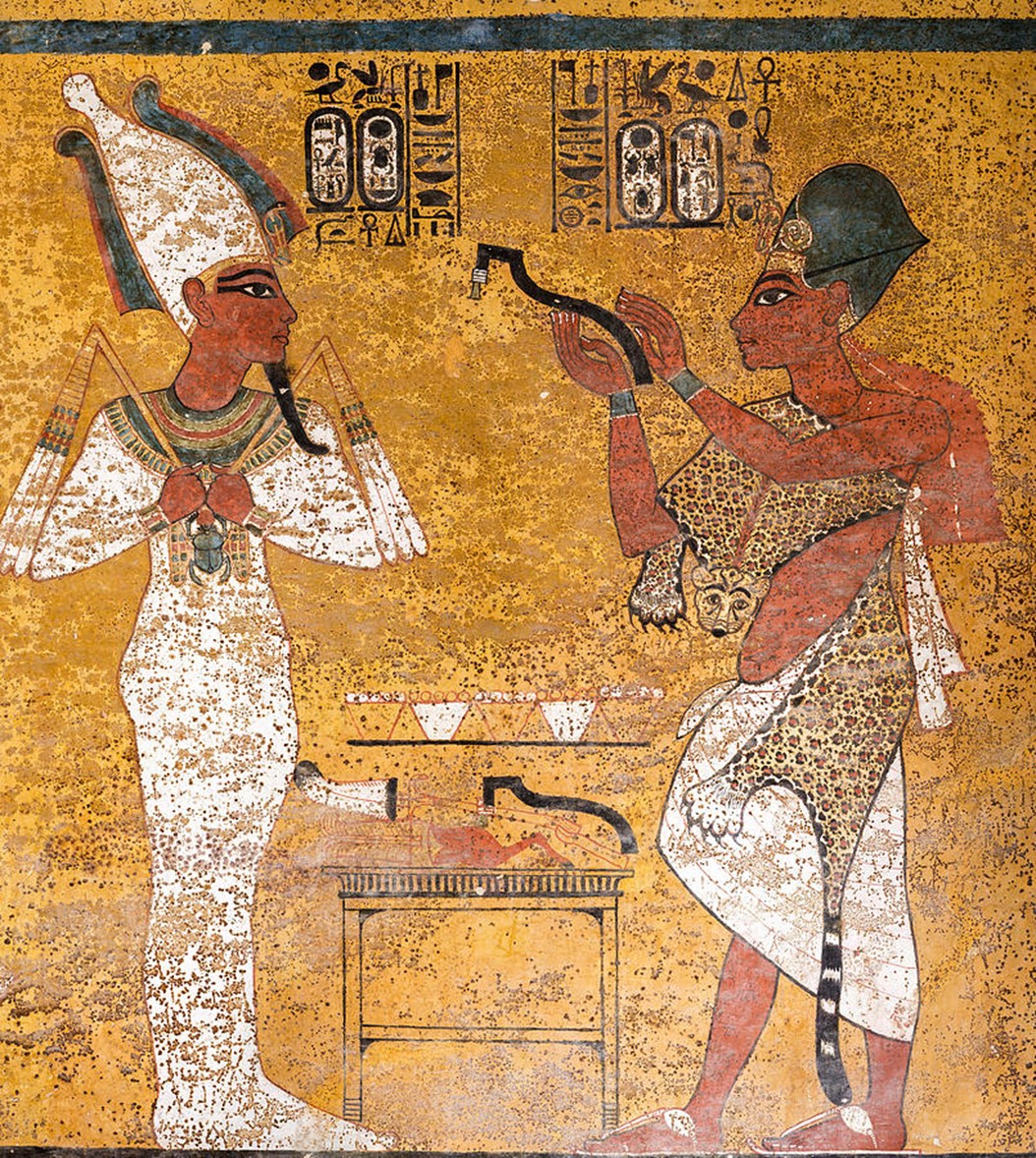
in a royal burial. It showed the Lord Ay using an adze to
perform
the Ceremony of the Opening of the Mouth on the mummified corpse of
King Nebkheperure-Tutankhamun.