Neferneferuaten:
Glorious is the Splendour
of the Sun
 By Robin Gordon
 Auksford 2024
©
Copyright
Robin Gordon, 2024
Auksford 2024
©
Copyright
Robin Gordon, 2024
PART IV:
ANKHKHEPERURE
16. Death
“Mnnngh!
I am truly
delighted that
Your Gracious Majesty has
honoured my
beloved
daughter by
making her your co-ruler – one of the very few
Queens-Regnant that our blessed homeland has had,”
said Lord Ay
to the King.
To the courtiers he said, “The elevation of my beloved daughter to
Queen-Regnant is a great honour for
my family.”
To his cronies
he said, “Although the elevation of my foster-daughter to
Queen-Regnant is a great honour for
my family
and confirms our
pre-eminent position in
the Two Lands, yet I fear
it may be an
error. Queen Maatkare did not hand over control of the
kingdom to
her stepson in her lifetime, and Nefertiti is, after all, a
foreigner.
I fear we may
have to be ready to defend our beloved
Prince Tutankhaten against the ambition of his stepmother.”
To his wife,
Tey, he said, “It’s a grave and serious insult and I shall
not forget
it or forgive it.
I have been at His Majesty’s
side from the start of his reign. I have helped him and spied for
him and warned him
of dangers. I
am his most loyal
follower, and
if anyone
should be made joint ruler that person is ME!”
Compared with the coronation of Akhenaten, that of Nefertiti
was
a simple affair. The gods had been abolished. The
role of
their high priests to bring forth the crowns of the Two Lands, Hedjet,
Deshret, Sekhemti, Atef and Khepresh over five days of feasting had
gone. The High Priest of the Aten alone remined, and he
placed on
Nefertiti’s head only the Blue Crown, Khepresh. She
received her throne name, Ankhkheperure, but not the names relating to
Hor or the Two Ladies, Nekhbet, the Vulture-goddess of the Valley, and
Wadjet, the Cobra-deity of the Delta.
Feasting there
was, as on all royal occasions, but nothing to compare with the
heb-seds of
former days, of with the coronations of earlier Kings.
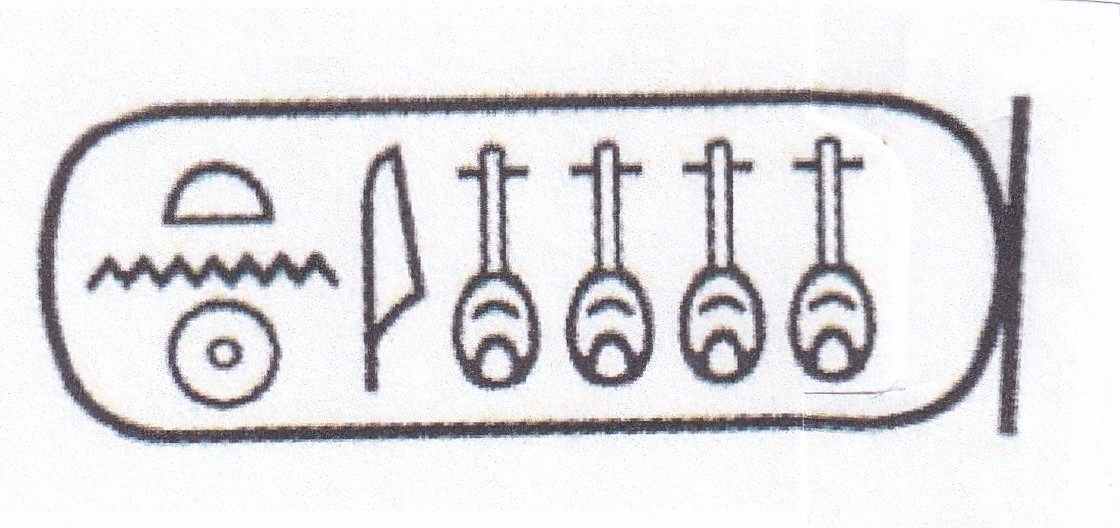
Nevertheless, Nefertiti, or, as she was now known,
Ankhkheperure-Neferneferuaten, was now co-ruler of the Two Lands, and
she set about her work of administration without delay. After
consultation with Queen Tiye she was determined to bring about some
form of reconciliation between Atenism and the old gods, but Akhenaten,
spurred on by Ay, was equally determined to punish Amun and his priests
for the murder of Kiya. This was the only policy on which
Akhenaten insisted. Ordinary affairs of governance no longer
interested him. Ay was ready, as always, to take on extra
responsibilities, but, now that there was another monarch at his side,
the King tended to leave more and more decisions to her. With
Queen Tiye to advise her, she inevitably made right ones. The
kingdom had never been so well ruled since the days of King
Nebmaatre-Amenhotep.
Ankhkheperure-Neferneferuaten
was not to benefit long from the advice of her practical
mother-in-law. Queen Tiye’s habit of travelling
frequently
between Akhetaten and Waset brought her into contact with more people
than other members of the royal family. She met the First Prophet of
Amun on many occasions but found it impossible to convince him that Ay
was behind the proscription of his god. She met the Mayor of
Waset, the Second Prophet of Amun, the Greatest of Seers, priests and
army officers. She tried her best to keep them loyal to the
royal
family, despite the orders emanating from the King, and she brought
back to Nefertiti news of their concerns, which Nefertiti tried to take
into consideration in the formation of government policy.
It was probably
this busy life of back and forward travel on behalf of Queen Nefertiti
that brought the Queen Mother into contact with the plague.
She
was at Akhetaten when the symptoms arrived. Akhenaten sent
for
the best doctors in the kingdom, but there was little they could do
beyond alleviating his mother’s suffering, and it was soon
apparent that the now elderly queen would soon die.
“Mmmnngh,
if my dear sister dies,”
said Ay to Tey, “that at least
will be a step towards
the restoration of truth, justice and
the proper
order of
things. Without Tiye
to guide her, that woman
will soon
find out how difficult it is to govern
the Two Lands. She will
have to
call on ME!”
Queen Tiye
died. Akhenaten was devastated. At the height of
his
fortune Fate had dealt him blow after blow. His beloved
little
girls, Neferneferure and Setepenre had died of the plague.
His
favourite daughter Meketaten had died of the plague. The
sister-wife he loved above all other women, even above his Queen, had
been foully murdered, and now his mother had been carried off by the
plague. Though he was the greatest King in the world, he
seemed
to be cursed. His god, the Aten, his divine Father, had
failed to
protect him. He knew that his own life was approaching its
end. His only aim now must be to ensure that the throne
passed to
his son, Tutankhaten, and for that he depended on Nefertiti.
He depended on
her, too, to organise the funeral of the Queen Mother.
Normally a
Queen who outlived her husband would be buried in a side-chamber of her
son’s tomb, but the side chambers already excavated were now
occupied by Kiya and by Meketaten and her little sisters. The
main tomb had only progressed as far as the shaft and the pillared
hall. There was still much work to do to extend it to the
actual
burial chamber. Akhenaten agreed that two of the pillars
should
be demolished and his mother’s sarcophagus placed in the hall
while a new side-chamber, to which she could be moved, was dug and
decorated. After that work would have to start to extend the
tomb
for the King himself.
The seventy
days of mourning passed. Nefertiti ordered the same
ceremonies
for the interment of Queen Tiye as had been used for
Meketaten.
Akhenaten, sunk in depression, made no contribution.
Afterwards
he left the government of the Two Lands entirely in her
hands. He
said he was occupied in planning his tomb, but, though his architects
waited in the anterooms to consult him, somehow nothing was ever
decided, and the tomb remained unfinished.
“King
Honky is on
the way out,”
sniggered Ay to Tey and Nakhtmin.
“That woman
will have to manage on
her own
without my dear sister
to guide
her, so
she will have to turn to someone with
experience to
help her – and who better than her beloved foster
father?”
Ay was partly
right. Akhenaten was plunged into grief and depression by the
deaths of his three daughters, his beloved sister-wife and his
mother. He spent long hours on his own doing nothing very
much,
his interest in affairs of state, always fairly vague and vacuous, was
now non-existent. He found comfort only in the presence of
Nefertiti, but she had a great deal to do as the monarch in charge of
the government. Ay was right: she needed the help and advice
of a
trustworthy ally – and she found one in Horemheb.
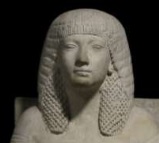 Horemheb
Horemheb had
been picked out by Queen Tiye, who, like her husband, had been a very
good judge of men and their talents. He had been promoted and
had
successfully carried out every task assigned to him. As a
scribe
he had been in charge of recruitment to the army, then he changed to a
military career and was now a general. Nefertiti picked him
out
to be her counsellor. She found him trustworthy and also
likeable, and, when she introduced him to her stepson, prince
Tutankhaten, the boy liked him too.
He did not like “Uncle” Ay very much, and Ay was
furious.
“That
woman has turned our beloved
little prince against
me,” he
spat. “How can a woman possibly act
as King?
It’s not natural. It’s against the
universal order
that governs the world –
and how can
she choose that upstart
Horemheb over her own foster-father, over ME, the brother of the
last
Queen?”
Horemheb had
much good advice for the Queen. He mediated between the Crown
and
the priesthoods of the old gods. It was on his advice that
she
changed her personal name from Neferneferuaten (Glorious is the
Splendour of the Sun) to Smenkhkare (Vigorous is the Soul of Re) as a
symbol of her wish to be reconciled with the old gods.
Akhenaten might
have objected, but Akhenaten was no longer interested in anything
much. It soon became obvious that the King’s life
was
slowly fading away. He took not the slightest interest in
governing the country. He took little interest in extending
his
tomb. He no longer even cared about his new Atenist religion.
Nefertiti as
Ankhkheperure-Smenkhkare governed with the advice of Horemheb, and
anything that needed the approval of the king himself just had to be
set aside. Reforms, which were much needed, were
impossible. The taxation system remained largely under the
control of Ay, and his tax collectors enriched themselves and their
master by exacting grossly unfair amounts from the peasant farmers and
leaving Ay’s followers largely untaxed.
At last came
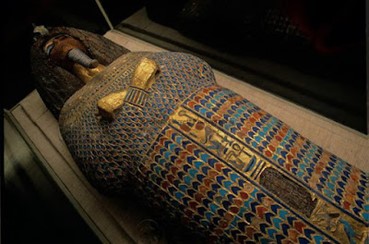
the day when Akhenaten was found lying dead in his bed. His
golden inner coffin and his gilded wooden outer coffins and his carved
stone sarcophagus were already prepared, the sarcophagus with four
images of Nefertiti replacing the traditional protective
goddesses. Mummification of the King’s body took
the
traditional 70 days, even though he had believed that his soul would
not either descend to the Field of Reeds or join the Sun-God Re in his
divine barque to help protect the world from destruction by the evil
serpent that hoped always to devour the sun. Instead it would
fly
around his land by day and rest in his tomb at night.
The tomb had
not been finished. A pit was excavated in the pillared hall
and
the King’s sarcophagus installed there, next to that of his
mother. His funeral was Atenist, based on the forms he had
ordered for Meketaten, but it did include the ceremony of the Opening
of the Mouth, and this was carried out by Ankhkheperure-Smenkhkare,
which confirmed her as ruler of the Two Lands with the absolute power
of all her predecessors.