Neferneferuaten:
Glorious is the Splendour
of the Sun
 By Robin Gordon
 Auksford 2024
©
Copyright
Robin Gordon, 2024
PART IV:
ANKHKHEPERURE
17.
Smenkhkare
Auksford 2024
©
Copyright
Robin Gordon, 2024
PART IV:
ANKHKHEPERURE
17.
Smenkhkare
An absolute ruler over the Two Lands? If only that
were
so. Ay was determined that it should not be. In
corridors,
in alleyways, in side-rooms, in anterooms, on staircases, in temples,
in offices, on streets, in gardens and parks, Ay was everywhere,
exercising his persuasive skills on men of influence: viziers,
generals, ministers, chief secretaries, priests, advisers and
counsellors.
“How can a mere woman be expected
to carry out
the
functions of a King
and rule over
the Two Lands as if she were a son of
Re or even
of the Aten,
shee-hee-hee-heeee?”
He reminded them all of the disastrous reign of Queen
Sobekkare-Sobekneferu. The Golden Age of King
Khakaura-Senwosret
and King Nimaatra-Amenemhat*1
was succeeded by a series of competing
kings from different families, the breakup of the Two Lands and the
occupation of the Delta by foreign rulers until King
Nebpehtire-Ahmose,*2
with the help and guidance of Amun, drove out the
invaders, back to the eastern coasts of the Great Green Sea, and
established control over those lands to prevent further incursions.
That woman,
that foreign woman,
that foreign
woman would lead
Kemet to destruction at the hands of other foreigners. It was
probably her influence, he suggested, that had led King
Neferkheperure-Waenre to abandon the religion of his forefathers,
forbid the worship of the gods that had created and maintained the Two
Lands since the beginning of time, and allow only worship of the
Aten. After all, as a foreigner,
she could have no feeling for
the history of Kemet, no knowledge of the way the gods had delivered
the Two Lands from utmost peril, no gratitude to Amun who had guided
and strengthened the Kings. She herself probably still
worshipped
the Storm-God Teshub, like the pagans of her homeland, and she probably
hated Amun because he had driven out the invaders from her part of the
world.
That foreign woman, he complained, had deceived her husband
in
order to seize the throne for herself. She had supplanted
poor
Prince Tutankhaten, the true heir, so that she could enjoy the
pleasures and privileges of kingship and complete her destruction of
Kemet. Any orders she might give should be treated with
suspicion, carefully examined, and, where necessary ignored,
countermanded or reversed.
Ay’s
agents even went out among the builders and labourers, warning them
that, now the King was dead, his ambitious building programme would
come to an end, and they would be unemployed and starve.
Nefertiti’s agents heard this and reported it back to
her.
She consulted Horemheb, and, on his advice, ordered the construction of
a huge, pillared hall to the south of the Great Palace.
Government ministers raised questions and doubts, but, after some
delay, allowed the project to go ahead. To Ay’s
fury,
Nefertiti ordered an increase in the builders’ rations, which
meant that, to keep up his own standard of luxury and that of his
followers, he was obliged to increase the levels of taxation paid by
the peasantry. It was all that woman’s
fault.
Ay made a point of visiting Tutankhaten every day.
The
little prince was not exactly delighted to have his playing time
interrupted by an elderly courtier, but Ay would bring him presents,
which he liked, and remind him that his grandfather and his father had
been kings of the richest and most powerful country in the
world.
Ay reminded him of the great jubilee, when all the other Great Kings,
and the lesser kings too, had sent presents and tribute to the Great
King of Kemet. He reminded him of the words of his mother and
of
his grandmother, promising that one day he would sit on the throne of
Kemet and wear the crowns of the Two Lands, and that one day all the
other kings of all the countries of the civilised world would bow
before him and send him tribute. Even if he didn’t
much
like old Ay, Tutankhaten was pleased and flattered by these reminders
of his importance and looked forward with pleasurable anticipation to
the time when he would assume all the rights and duties of King.
Ay began by
telling him how lucky he was to have Nefertiti looking after the
kingdom for him so that he could spend his childhood learning about how
to govern and have plenty of time for playing. Ay praised
Nefertiti for her wisdom and ability and assured Tutankhaten that Kemet
was in good hands and would come to him in good condition, ready for
him to make his mark on the world like his famous ancestor King
Menkheperre-Djehutymose who had conquered all of the east coast of the
Great Green Sea and fought the famous Battle of Megiddo which would be
remembered as long as the world lasted. Against the cautious
advice of his generals, King Menkheperre led his armies by the most
direct route over the hills, even though this meant a dangerous
three-day march through a narrow defile. The enemy, expecting
an
approach around the hills, were caught unawares, and the King achieved
one of the greatest victories in the whole history of the world.
Ay soon realised that the little prince loved these stories
about
the heroic deeds of his ancestors and saw himself as a future
conqueror. He had started having pains in his left foot, but
Ay
assured him that these would pass and he would be the greatest King the
Two Lands had ever had.
As time passed Ay assured him that, when he came of age, he
would
be crowned King, and, like his famous ancestor, he would lead his army,
put down the rebellious vassal states and even put an end to the
growing power of Hatti.
More time passed, and Ay remembered, with apparent
reluctance,
that King Menkheperre-Djehutymose was kept subservient to
Maatkare-Hatshepsut and could not begin the conquests, that would make
his name live forever, until his stepmother had died.
As more time passed Ay began to hint that Queen-Regnant
Ankhkheperure-Smenkhkare was perhaps not as competent as she supposed,
and that she enjoyed having supreme power over the Two Lands so much
that she would be reluctant to share it, even with the rightful heir.
In this crafty way he slid from truth to half-truth, from
there
to insinuation and innuendo, and then, having well-prepared the ground,
to downright lies. He even managed to hint that, as a
foreigner,
Nefertiti wanted to subordinate Kemet to her homeland, Mitanni, and
that, while he himself would never believe it, there were those who
suspected her of the murder of Kiya, so that she, rather than Kiya,
could become regent if Akhenaten should die before his son was old
enough to reign as King.
“Uncle Ay says Smenkhkare won’t ever let
me be
King,” Tutankhaten complained to his favourite sister and
constant companion, Ankhesenpaaten. “He says she
murdered
Mummy to make herself regent and she wants to keep the throne for
herself. It isn’t fair.”
Ankhesenpaaten was massaging his sore foot at the time.
“You don’t want to believe everything
Lord Ay
says,” she told him. “My Mummy has always
been good
to you. I don’t believe she had anything to do with
your
Mummy’s death. Granny proved it was arranged by one
of
Ay’s servants, and she always thought it was that nasty
Nakhtmin
that killed your Mummy.”
“Maybe,” said the little boy, but he
still chafed, he
was still cross and discontented, and his foot seemed to hurt more and
more.
Ankhesenpaaten went to find Smenkhkare and told her what
Tutankhaten had said, so the little prince had a surprise a few days
later when the Queen-Regnant came to see him and told him that she was
going to arrange for him to be crowned joint monarch.
Though she herself had been crowned only by the High Priest
of
the Aten in Akhetaten, Nefertiti decided that Tutankhaten’s
coronation should incorporate all of the traditional
ceremonies.
He would receive the five crowns of Kemet from the priests of the old
gods: the White Crown of the upper lands, Hedjet; the Red Crown of the
Delta, Deshret; the Double Crown of the Two Lands, Sekhemti; the
Atef-Crown of Usír; and the Blue Crown, Khepresh.
He would
be hailed as Nebkheperure, King of the Two lands, Son of Re,
Tutankhaten, ruler of Waset, and all this would take place in the great
temples of Waset, with five days of feasting as the whole country
rejoiced.
Tutankhaten was happy, and his foot seemed to hurt much
less. It was Ay who was unhappy, furious at the cunning of that
woman, who seemed determined to undermine his position as
rightful
chief counsellor of the legitimate heir to the throne. It did
not
take him long, however, to see how he could turn the situation to his
advantage. In his next few visits to Tutankhaten he
congratulated
the boy on his elevation to the throne, somehow managed to hint that
this was all due to his own influence over Smenkhkare, and then hinted
that, since he had been Fan-Bearer on the Right of the King to
Tutankhaten’s father and grandfather, there was no-one better
to
be the new King’s Fan-Bearer and closest counsellor than
himself. Somehow Tutankhaten gained the impression that
Smenkhkare would have chosen Ay as her Fan-Bearer if she had not been
afraid that people would have accused her of undue favouritism in
choosing her beloved foster father, that if she had done so everyone
would have been reminded of her foreign origins, and that she was
anxious that Tutankhaten should choose Ay as his chief counsellor.
The little boy was only seven. He didn’t
want to
offend his co-ruler. He found it difficult to stand up to the
pressure put on him by a man who might have been his granny’s
brother. He gave way, and Ay was once again a permanent
presence
at all government meetings.
“Of course he wasn’t Granny’s
brother,”
said Ankhesenpaaten. “He’s nothing to do
with our
family. The Queen is going to be cross about this.”
“It isn’t fair!” shouted
Tutankhaten.
“I hate you! I hate you – and I hate
Ay!
He’s a bully and a liar.”
“What’s all this?” said
Horemheb, coming into the room.
“Nothing!” snarled Tutankhaten
“Ay made Tut appoint him fan-bearer,”
said
Ankhesenpaaten. “He said that’s what the
Queen would
want. Now she’s going to be furious.”
“He’s a liar. He’s a
rotten, stinking liar,” wailed Tutankhaten.
“Well, you’re right there,”
said
Horemheb. “We all know he’s a
liar.”
“He said it was all his idea to make me
King,” said
Tutankhaten. “He said he persuaded Aunty Nefert*3
or she
wouldn’t have done it.”
“Well, that’s
a lie,” said Horemheb.
“Smenkhkare only agreed to be crowned so that she could keep
the
throne safe for you. She thinks Ay would like to find some
way of
grabbing it for himself. She won’t be pleased that
Ay has
pulled this latest trick, but I’ll explain it to her, and
we’ll just have to work together to keep Ay from making too
much
trouble.”
“Oh, thank you, Uncle Hory,” said
Tutankhaten.
“Well, you know I’d do anything for you,
Your
Majesty,” said Horemheb, and went to explain to Smenkhkare
what
had happened.
“Did you hear that?” said
Tutankhaten. “He called me Majesty!”
“Well, so you are. You are Your
Majesty,” said
Ankhesenpaaten, “or at least you will be when
you’re
crowned.”
Tutankhaten’s foot began to hurt again when he
heard that
the Queen Regnant herself was on her way to see him. When she
arrived Horemheb was with her, and he gave the trembling prince a
quick, reassuring grin.
Aunty Nefert bent down, kissed him and embraced him.
“I thought you’d be cross,” he
murmured.
“I’m furious,” she said,
“but not with
you, darling. I’m furious with Ay. You
know,
Ankhesenpaaten is quite right: he’s not your
granny’s
brother. She told me all about him when I first came to
Kemet. When she married your grandpa and became Queen, Ay
married
her cousin to get a connection to the royal family.
Granny’s real brother became Second Prophet of Amun, and Ay
persuaded Granny’s father to make over to him the various
offices
he held, claiming that was the best way to keep them in the
family. That was how he got to be Commander of the
King’s
cavalry and a priest of Min. As a priest he was
allowed to
call anyone he liked ‘my brother’ or ‘my
sister’, but he made sure that the one person he always
called
sister was the Queen. Your granny disliked him, and she used
to
make fun of him. Did you know that she could imitate
people’s voices?”
The children nodded.
“I got quite a shock when she suddenly started
using
Ay’s voice in the middle of our first talk
together,” said
the Queen. “She was a really brilliant mimic. Now,
Horemheb
has told me all about how Ay deceived you into making him your
Fan-Bearer. What we have to do is decide between ourselves
what
decision we want to make before it ever comes to a meeting where he can
interfere. In the meantime, I want you to do is concentrate
on
your school work. Your tutors will teach you everything about
the
history of the Two Lands, how to read and write, how to govern, how to
be a King of Kemet.”
The coronation was a great success. Feasting and
revelry
took place all over the Two lands. Drunkenness could once
more be
dedicated to Hwt-Hor and excused as a celebration of the deliverance of
Man from the rage of Sekhmet. It was Horemheb and Smenkhkare
who
had decided that the young King should have a traditional coronation,
with the five crowns and the participation of the priests of the old
gods, but it was Ay who got the credit.
In conversation with his old friend the First Prophet of
Amun, Ay
managed to suggest, without ever making any statement that could be
challenged, that, while he regarded a woman acting as a king as
contrary to the universal order symbolised by the goddess Maat,
daughter of Re the creator of the world, he thought that she might be
more amenable to rational argument in favour of the ancient traditions
of Kemet than her husband had been. Somehow, without ever
saying
so directly, he was able to give the First Prophet the impression that
he himself had inspired the Queen-Regnant to take on her stepson as her
partner in the government of the Two Lands, and that it was he who had
persuaded her to agree to the traditional coronation. The
fact
that he never said so directly was regarded by the First Prophet as
another point in his favour. The Lord Ay had brought about a
major step forward in the reconciliation between the Royal Family and
the traditional gods, he had made a great contribution to the
restoration of maat,
the universal order of the world, and, at the same
time he modestly refrained from taking the credit that was his
due. What a truly great and gifted man he was.
Hearing the long-winded reports of the viziers to their
monarchs
was not at all interesting to King Tutankhaten. He would
rather
play with his sister or his schoolfriends. He would even
rather
sit in school and learn his lessons. The history of the Two
Lands
and the exploits of his ancestors and their predecessors was quite
fascinating, especially to a boy who knew that he too would join the
long line of Kings of Kemet stretching back one and a half thousand
years. He was happy to let his senior partner,
Ankhkheperure-Smenkhkare deal with the business of government for the
time being, despite the hints and suggestions from Ay that he should
keep a closer watch on that
woman and her cronies.
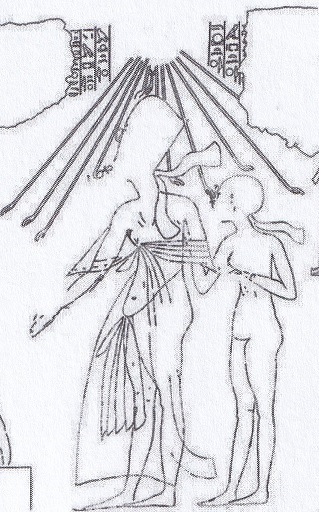
Smenkhkare
& Meritaten
Notes
*1 Khakaura-Senwosret
and Nimaatra-Amenemhat
The fifth King of the 12th Dynasty, whose names mean “The
Souls
of Re have appeared – Man of Wosret” (i.e.Waset),
and the
sixth King of the 12th Dynasty, “The One who belongs to the
Maat
(order and justice) of Re – Amun is at the
Forefront”. Amenemhat III was succeeded by
Amenemhat IV who
was followed by Sobekneferu, after whose reign the Middle Kingdom
collapsed into the chaos of the Second Intermediate period.
Back to text
*2 Nebpehtire-Ahmose
Ahmose I was the first King of the 18th Dynasty. His throne
name
means “The Lord of Strength is Re” and his personal
name
“Child of [the Moon God] Ah”.
He was the son of Seqenenre-Tao, the second last King of the 17th
Dynasty, and the brother of Kamose, the last King of that Dynasty, both
of whom perished in the struggle to drive the Hyksos out of
Egypt. Ahmose completed the reconquest of the Delta and drove
the
Asiatic invaders back to the Syria-Palestine area.
It has been suggested that the Plagues of Egypt described in Exodus
could have resulted from the eruption of Santorini, the date of which
is most likely to have been during the reign of Ahmose I, and may be
the events referred to in the Tempest stele which he issued and which
was discovered broken in pieces. Among the fragments are the following:
“The gods expressed their discontent …The gods
made the
sky come with a tempest … it caused darkness …
all that
existed had been annihilated. (See Introduction: 2. The reign
of
Ahmose I with an excursus on Exodus).
Back to text
*3 Nefert
Nefer (beautiful) plus the feminine ending -t (beautiful woman)
Back to text