Neferneferuaten:
Glorious is the Splendour
of the Sun
 By Robin Gordon
 Auksford 2024
©
Copyright
Robin Gordon, 2024
PART II: NEBMAATRE
8.
Queen Tiye
Auksford 2024
©
Copyright
Robin Gordon, 2024
PART II: NEBMAATRE
8.
Queen Tiye
More and more Taduḥepa came to dislike Ay and Tey, but
leaving
them would be like moving from the cooking pot into the fire.
“I have to spend far too much time with that
foreign
brat,” she heard Tey’s whining voice complaining to
one of
her visitors. “I’m the wife of one of the most
important
men in the Two Lands, and all I ever get to do is teach the stupid girl
about our country.”
“Isn’t that what her tutors are
for?”
“You know as well as I do that there are things
these men
can’t teach: attitudes, the right way of behaving.
I spend
hours with her, I do the best I can for her, but she shows no gratitude
at all. She still doesn’t seem to understand a word
of our
language despite all the help I give her. Well I’m
getting
sick of it. All I am these days is nursemaid to that
Tadukhepa.”
Taduḥepa could stand it no longer. She burst into
the room to confront Tey.
“When I am Mistress of the Two Lands,”
she shouted,
“your proudest boast will be that you were nursemaid to
Taduḥepa. You’ll put it in your tomb so that
everyone
remembers: Tey, nursemaid to Taduḥepa, Queen of the Two
Lands!” *1
The visitor, behind her, coughed. Taduḥepa spun
round. It was Queen Tiye.
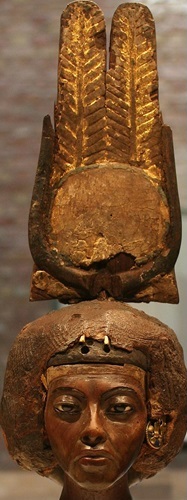
Queen
Tiye
“Oh!” she gasped.
She dropped to her knees. “Oh, Majesty, I
think I say
maybe wrong. I not understand well what lady say.”
“I think you understood perfectly,” said
the
Queen. “It’s clear that your knowledge of
our
language is much
better than you want us to think. It’s time you and
I had a little talk.”
The Queen glanced round.
“Leave us!” she commanded, and the
attendant servants immediately vanished.
“You as well, Tey,” snapped the Queen,
“and no
listening at the door. Understand?”
Tey went, with bad grace, muttering under her breath about
the
indignity of being ordered out of a room in her own house.
Taduḥepa, still on her knees began to apologise.
She could
see there was no use in pretending not to speak the southern language.
“I’m sorry, Your Majesty. I
should never have
spoken so rudely to your brother’s wife.”
“Get up, girl,” said the Queen.
“First of
all, let’s get one thing clear: Ay is not my brother and I
never
intended you to come to this house. We’ll have the
rest of
our talk at my palace. I don’t trust Tey not to be
listening somewhere.”
Queen Tiye opened the door and called one of her
servants.
Tey’s carrying chair was brought to the door.
Taduḥepa
mounted, the Queen got into her own chair, and they set off for the
short distance to her private apartments.
“So,” said the Queen,
“you’re the girl
who is going to replace me as Mistress of the Two Lands. But
your
problem is you find the King repulsive. He’s old,
he’s fat, his teeth are rotten, his breath smells and
he’s
irritable and short-tempered. You would prefer a boy of your
own
age, wouldn’t you? Like the young man who
couldn’t
take his eyes off you at the ceremony?”
“Oh, Your Majesty, I’m sure he meant no
harm. Please don’t tell the King.”
“You wouldn’t want him to be executed for
looking
with lustful eyes on the King’s latest female
acquisition?”
“Of course not. He hasn’t done
anything wrong.”
“You needn’t worry about that.
That young man
is our son, the next King. In fact I’ve more or
less
persuaded my husband to make him co-ruler at his next heb-sed which
will be next year. You’re looking
puzzled?”
“Heb-sed?”
“It’s an old tradition dating right back
to the
beginning of our country, when the Two Lands were first brought
together by the great King Narmer, when the Kings were treated as gods
even in their lifetimes and buried in those huge pyramids that tourists
from the other great kingdoms come to admire. If a King ruled
for
30 years he would have been rather old, so he had to prove he was still
fit to rule by running round a marked course. He was then
re-sanctified as King.
“Of course it fell out of use over the centuries,
some
kings ruled for years without ever having a heb-sed and some
had what
they called heb-seds
after quite short reigns, though the bit about
proving their fitness never came into it. My husband has
always
been interested in history, so he revived the ceremonies, with the help
of his chief minister Amenhotep son of Hapu, and of course the people
love it. There’s never any reluctance for a
festival with
weeks of feasting and drinking here.
“You probably heard about our big heb-sed festival
six
years ago. It was the biggest festival ever. People
came
from all over Kemet and from Kush and Mitanni and Babylon.
All
coming to honour the Great King Nebmaatre-Amenhotep –
Nimmureya
as you call him – and that’s when things started to
go
wrong.
“Amenhotep was perfectly well and strong, but he
knew that
after ruling for 30 years he couldn’t go on forever, so the
heb-sed was
going to culminate in making our son Djehutymose*2
junior
King, but with all these people flooding into Waset*3
… well,
of course some of them brought the plague. Djehutymose caught
it
and he lay sick throughout the festival. We
couldn’t cancel
it, we just had to go on.
“What could we do about the role of the Crown
Prince?
His younger brother couldn’t take it on. That would
have
been tempting fate, the equivalent of accepting that our son was as
good as dead. We needed someone who could act the part
without
implying that Djehutymose was dying. Ay, of course, put
himself
forward.”
Suddenly, to Taduḥepa’s surprise, the Queen adopted
a
slightly exaggerated version of Ay’s sibillant and slightly
nasal
confidentiality: “Nnnngh!
I would be most
willing to act the part
of Crown
Prince in the celebration, shee-heee-hee-heee.”
“Of course,” continued the Queen in her
normal
voice, “we couldn’t allow that. Amenhotep
son of Hapu
stepped in. At least we knew we could trust him not to twist
things and somehow claim he’s been made heir to the throne.
“Now look, Tadukhepa, it’s time for us to
put our senet
pieces on the board.”
“What?”
“Oh, senet,
it’s a board game. I mean,
it’s time for us both to be clear where we stand.
You want
to be Queen of the Two Lands but you don’t want to marry King
Nebmaatre-Amenhotep. You’ve probably been led to
believe by
Ay and Tey that I am your implacable enemy, but in fact we both want
the same thing. I want you to be Queen of the Two Lands, but
not
by marrying the present King, but by marrying our son. That
way
you get to be Queen and I become Queen Mother, and between us we can
work together to guide the new King when his father has gone to join
the gods.”
“Prince Tsehutymose?”
“No. He died. Back in year
30. His
younger brother, Prince Amenhotep. The boy who was looking at
you
so intently at the welcome ceremony.” Are we agreed?
“Er … yes.”
“Good,” said the Queen.
“The next thing
is for you to write secretly to your father to ask him to stop pressing
for your marriage to the King to go ahead as soon as
possible. My
poor old Amenhotep is not going to last much longer anyway.”
“I never understood,” said Taduḥepa,
“why the
King ever agreed to make me Mistress of the Two Lands.”
“Toothache,” said Queen Tiye.
“He suffers
agonising pain all the time. We get opium from Alashiya.*4
It’s the only way he can cope. He can’t
manage
meetings any more. When the pain gets unbearable he just
agrees
to whatever has been proposed so that he can bring things to an end and
get back to his private quarters for a dose of opium.
“You saw how he was at the welcome
ceremony. I
suggested you needed time to learn about our country and its culture
and he agreed at once. I was just about to suggest a very
nice
couple to look after you, when Ay cut in – Nnngh!
Nnngh! My wife and I
would be most
willing, etc. – and
Amenhotep agreed at once. Your interpreter only just asked in
time to have your sister with you. Ay, of course
didn’t
want her. He thought you’d be more under his
influence if
you were alone, but I cut in quickly and told Amenhotep we’d
finish the meeting more quickly if he agreed. So there you
are.”
“Oh. I thought you didn’t want
me to have Puduḥepa with me.”
“Well, that’s only natural, given that
you thought
you were coming to kick me off my throne, but of course I wanted you to
have a companion. Being alone with that pair would have
probably
sent you mad. Next time you come over for a chat bring
Pudukhepa
with you. I’ll send over two carrying
chairs. I know
you could walk, it’s only just across the palace area, but I
doubt if Ay and Tey would just let you stroll out of their house
whenever it suited you. As far as they’re concerned
you’re a bargaining counter. They’re
holding back
till they find out whether you are to be eliminated by me or if
I’m to be eliminated by you.
“You’re probably wondering how Ay got
himself into
such a privileged position if he isn’t actually my
brother.”
“Well … yes.”
“It’s a long story, but you’ll
understand how
things are here if I start right back at the beginning.
“I was just a little girl, probably about ten years
old,
when King Menkheperure-Djehutymose*5
died, and his son, Amenhotep was
only about twelve, so, as usually happened when a young boy became
King, his mother was made regent. Now, her name was Mutemwia,
but
she was quite a feeble creature. The really dominant woman at
court was the old King’s mother, Queen Tiaa, and she, as it
happens, was my great aunt, so, you can see, it wasn’t long
before she set to work to fix up a marriage between her grandson, the
new King, and her great niece: me.*6
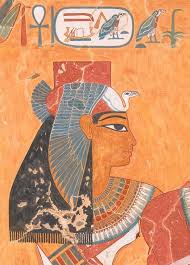
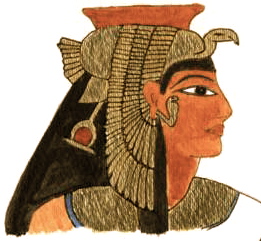 Queen
Mutemwia
Queen Tiaa
Queen
Mutemwia
Queen Tiaa
“Now, my father was called Yuya, and he was
commander of
chariots in the King’s army, and also a priest of Min and
Superintendent of the Cattle of Min.*7
My mother, who was called
Tjuyu was Superintendent of the Household of Min and Chief of the
Entertainers of Min and Amun. I had one brother,
Anen. He
was older than I was, and when the Fourth Prophet of Amun died, Tiaa
decided that he should be appointed. The priests of Amun had
become much too powerful and she thought it would be a good thing to
have a member of the King’s family in one of the top
positions. “Now, normally the
priests might
have been suspicious of any such move, but Amenhotep was a new young
king, and it was a sort of honeymoon period, so they agreed, and Anen
became Fourth Prophet even though he was still rather young for such a
position. He was very successful and was soon promoted to
Second
Prophet. Now that is a particularly powerful position because
he
controls all the lands and estates, leaving the First Prophet free to
serve the god and interfere in politics. He probably could
have
become First Prophet if he had wanted, but he thought he was more
useful as head of the estates, and in any case his health was beginning
to fail. He died a few years ago, so the family no longer has
any
influence over Amun.
“A few years after I became Queen a boy called Ay
was born
in Khent-Min. He grew up to be very ambitious, and he set his
heart on marrying a girl called Tey. It’s really
the same
name as mine, but we always called her Tey rather than Tiye, just so
people could tell us apart, because Tey is my cousin, the daughter of
my father’s younger brother.
“Once he was in the family, he made his next move,
and that
was to persuade his uncle Yuya that, since Anen was already Second
Prophet of Amun and likely to be promoted to First Prophet, which would
have made him the second most important man in the kingdom, and that
therefore he wouldn’t want to bother with the chariots and
the
priesthoods of Min, the family might lose them unless they could be
passed to another member. Ay can be very persuasive, so, when
my
father died, Ay became Commander of the King’s Chariots and
Superintendent of the Cattle of Min.*8
“As a priest of Min he could call anyone nnngh My Brother
or My Sister,
though he was actually quite selective. When he
came to court he made sure everyone knew he was Yuya’s heir,
that
he came from Khent-Min like me, and he always referred to me as his
sister, so that eventually people who didn’t know any better
began to accept him as my brother.
“He then used this confusion to further his own
career. Whenever an important office came up he would smarm
around the men who controlled it and tell them how important it was to
the King to have someone he could trust in charge of it, and drag in
the odd reference to my dear
sister the Queen, so that they thought it
would please the King if they promoted Ay. Then, when he got
near
enough to the King, he began to play on him with his confidential
whispers, and he learned just how far he could go, and when the King
was getting pains from his abscesses and would agree to anything to
bring the meeting to an end and get himself some opium.
That’s how he got himself appointed Fan-Bearer, so, much to
Amenhotep’s horror, Ay is now always around him.
“Now, look, Tadukhepa. It’s
about time that I
was sending you home. Be careful what you say to Ay and Tey,
and
even what you say to Pudukhepa. There are always spies
around.”
“We always talk Mitannian.”
“What about the interpreter?
“Oh, yes. He’s usually with
us.”
“And,” said the Queen, Ay got rid of your
interpreter. The man you have now is one of his servants.
Don’t say anything to Pudukhepa while he’s with
you.
Wait till you are in your own bedroom, alone, and keep your voice right
down.”
“You think they listen?”
“I’m sure of it. Another thing:
Ay will
probably ask you at dinner what we talked about.
Don’t tell
him anything. Try and flatter him if you can. Make
him
think you rely on him to keep you safe. I’ll send
for you
and Pudukhepa tomorrow, and I’ll have my son here to meet you
… There is perhaps one thing you should know about
Amenhotep. He has a bit of a speech defect.
He’s all
right when he’s speaking quietly, but when he gets excited he
begins to honk a bit. It’s a cleft palate you
see.
Nothing serious, but it does mean he won’t be terribly good
at
making speeches. That’s another reason he needs a
good wife
at his side.”
Queen Tiye then called servants to bring Tey’s
carrying chair and take Taduḥepa home.
There she was met by Puduḥepa.
“Oh, where have you been, Tadu? Tey said
you had been
carried off by Queen Tiye and I’d never see you
again. She
knows we can speak their language. I don’t know how
she
found out.”
“My fault,” said Taduḥepa.
“I heard her
telling a visitor what a nuisance it was having us here and how she was
nothing more than a nurse maid to a foreign brat, and I was so furious
that I couldn’t stop myself. I told her the day
would come
when she’d be so proud of her connection to me that
she’d
put it in her tomb.”
“Oh! What did she say?”
“Nothing, because the visitor turned out to be the
Queen.”
“And she took you away?”
Taduḥepa turned to the interpreter.
“Leave us!” she commanded in the southern
tongue and
in the tone Queen Tiye had used to the servants.
“No, Your Highness, I’m afraid I
can’t.
My orders are to stay with you at all times in case you need me to
interpret for you.”
“Since you now know I can speak your language quite
well, you know I don’t need you.”
“My orders come from the Lord Ay, and I must obey
them until he changes them.”
“I’m going to change my clothes for
dinner,” said Taduḥepa.
“I’ll be close at hand if you need
me,” said the interpreter.”
Taduḥepa switched back to Mitannian.
“Come with me, Pudu.”
Once inside her bedroom she whispered: “I
can’t tell
you now, because he’s listening, and he reports everything we
say
back to Ay and Tey. That’s why Tey was in such a
fury when
I heard her talking to the Queen. She’s heard
everything
we’ve said about her. PASS ME MY OTHER DRESS,
PLEASE!
That’s for him.
I had a long talk with the Queen. I
rather like her. SHOULD I WEAR THAT SASH DO YOU
THINK?
I’m not going to let Ay know anything about it. In
fact,
I’ll let him think I’m afraid of her, but you
mustn’t
be scared about anything I say.”
“I hear
you had a long
talk with my dear sister
the
Queen,” said Ay. “How did you get on with
her?
Do tell me, and I know
you can speak our
language perfectly well.
Perhaps you might like to tell me why
you pretended that
you
couldn’t.”
“Of course I will,” said
Taduḥepa. “At
first it was because I didn’t know what would happen to me if
I
went into the Royal household. The King is old and ill, and
– I have to admit – not very attractive to a young
girl
like me, and the Queen wouldn’t want me there because my
father
insisted I should be Mistress of the Two Lands. I felt much
safer
here with you.”
“And now
that you have met
the Queen?”
“I’m rather afraid of her,”
said
Taduḥepa. “She’s a very strong woman,
very
powerful. I’m really very thankful to have you as
my
protector. You’ve really become a second father to
me, and
you Tey, you’re really like a second mother. I know
I was
rude to you today, but it was because I was so upset to think that you
didn’t like me.”
“Do you really
think of me
as a second father?”
Ay asked.
“I’m relying on you to protect
me,” said
Taduḥepa. “I have to see the Queen again tomorrow
and take
Puduḥepa with me. The only reason I can face her again so
soon is
that I know she won’t harm anyone who is under her
brother’s protection.”
“Oh!”
murmured Ay. “I suppose
that’s true. My dear sister
wouldn’t harm you if I
adopt you as my foster-daughter.”
“I really am grateful,” said Taduḥepa
with a skilfully feigned tearful smile.
Afterwards Tey voiced suspicion, but Ay was so full of his
own
importance that he was inclined to believe the princess.
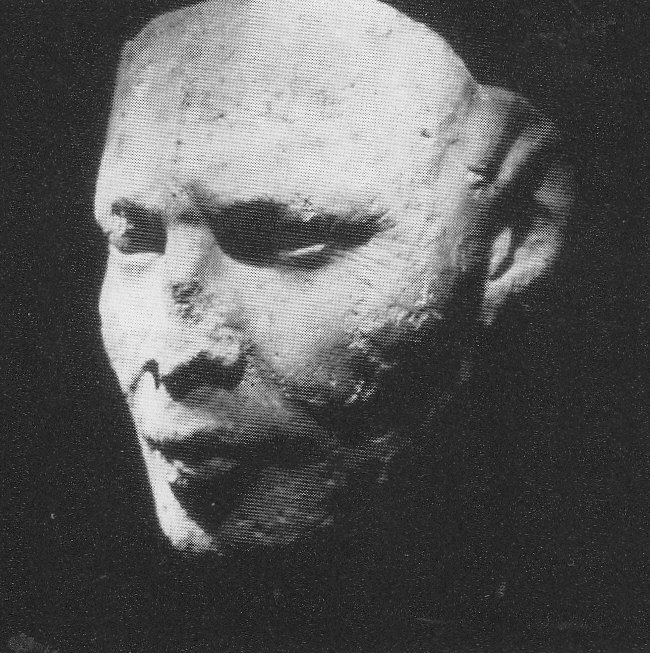
Ay
“Look
at it this
way, even if she is being deceitful
she’s going to present me
as her foster-father,
so, whichever old
King Fatso chooses as Queen, I’m either her father or her brother
as far as the court is concerned. Besides, have you
seen how
young Amenhotep looks
at her. If Fatso kicks the bucket, King
Honky will grab her for himself, and
I’ll be brother
of the Queen
Mother and father of the Queen. Eunnngh! We
can’t
lose!”
Notes
*1 Nursemaid
Tey did describe herself in her tomb as
“Nurse
to the Great Royal Wife” which has led to speculation that
Nefertiti was Ay’s daughter by a wife previous to the already
hypothetical wife who some claim preceded Tey and was the mother of
Nakhtmin. There is no evidence for any of this.
Back to text
*2 Djehutymose
The name means Child of Thoth (Djehuty),
or Born of
Thoth, or even Thoth is Born. It is usually spelt Thutmose or
Tuthmose or, in the Greek form, Tuthmosis, and it appears in some older
works using latinized Greek as Thothmes.
Back to text
*3 Waset
The City of the Sceptre, the religious
capital of
Egypt. It was called by the Greeks “Thebes of the
Hundred
Gates”, to distinguish it from Seven-gated Thebes in Greece,
referring to the many pylons or gateways to the temple complex.
Back to text
*4
Alashiya
Cyprus
Back to text
*5 King
Menkheperure-Djehutymose
Eternal-are-the-Manifestations-of-Re
Child-of-Thoth, i.e. Thutmose IV, the father of Amenhotep III.
Back to text
*6 Tiaa and Mutemwia
My version of this story is based on the
similarity
of the names Tiaa and Tiye, similarities of names being often used by
Egyptologists to claim that relationships exist. Tiaa’s
parentage
is unknown, but, since she is never referred to as
“King’s
daughter” it is clear that she did not belong to the royal
family.
Further, Tiaa was not buried in the tombs of either her husband,
Amenhotep II, or her son, Thutmose IV, which suggests that she outlived
both of them and would therefore have been still alive at the accession
of her grandson, Amenhotep III.
The suggestion made by Cyril Aldred that Mutemwia, the mother of
Amenhotep III may have been related to Yuya, Tiye’s father,
and
may therefore have been instrumental in arranging the marriage of Tiye
to Amenhotep III, is not supported by any evidence and is not now
accepted.
Back to text
*7 Min
A male fertility god, the centre of
whose worship
was Khent-Min, (now called in Arabic Akhmim. The Greek name
was
Panopolis).
Back to text
*8 Commander of the
King’s Chariots
Some Egyptologists interpret the fact
that Ay
inherited Yuya’s offices as an indication that he was a son
of
Yuya and therefore Tiye’s brother, but Anen, who became
Second
prophet of Amun, is the only son of Yuya and brother of Tiye who is
ever mentioned in the records. Ay’s monuments never
mention
his parents’ names, but it would seem likely that if he had a
genuine connection to the royal family, even indirectly, by being the
son of the Queen’s parents, he would not have failed to
mention
it.
My view of Ay’s character is determined by the facts
surrounding
the death of Tutankhamun and Ay’s accession to the
throne.
Horemheb was the King’s Deputy and therefore heir
presumptive,
yet Ay became King after the hurried mummification of Tutankhamun and
his interment in an obviously rapidly prepared non-royal tomb.
Ay is obviously a usurper, and the fact
that
Horemheb, who followed Ay as King, had to repeat the reforms he had
already undertaken as Tutankhamun’s Deputy, suggest that Ay,
during his short reign, had allowed the abuses to return, or even
encouraged them.
I therefore see Ay as a hypocrite whose
whole career
is based on lies. Readers familiar with my other works will
recognize this portrayal as another version of my sniggering hypocrite
character.
Back to text