Neferneferuaten:
Glorious is the Splendour
of the Sun
 By Robin Gordon
 Auksford 2024
©
Copyright
Robin Gordon, 2024
PART
III:
NEFERKHEPERURE-
WAENRE
15. Murder
Auksford 2024
©
Copyright
Robin Gordon, 2024
PART
III:
NEFERKHEPERURE-
WAENRE
15. Murder
Alarm and confusion! Crying and
screaming! Weeping
and wailing. The noise penetrated to the office where the
King
was meeting with his top officials, and to the parlour where the Queen
was taking a little refreshment with the Queen-Mother and hearing from
her all about public opinion in Waset and what the priests of Amun were
really thinking and saying. The King and the Queens rushed
out
and joined the stream of scribes and servants hurrying towards the
commotion. There, to their horror, they found Queen Kiya, the
King’s best beloved, the sister-wife who had been his only
consolation when his brother died, who had been his constant companion
ever since, and who had provided him with his heir, lying on the
ground, her face brutally smashed in, and, near her, the dead body of a
young scribe, still clutching in his right hand a bloody cudgel, the
murder weapon.
Nearby was Ay, and with him General Nakhtmin, holding a
bloody sword.
“Mnnnghgh!
Your Majesty!
We found this man
attacking
poor Queen Kiya.
Nakhtmin rushed to rescue
her and kill
her
assailant, but
we were too
late! Poor Kiya is dead.
Nnngh-nnngh-nnnngh!
I’m told
that the beast
who attacked
her is a
member of
the staff of Queen Neferneferuaten.”
“His name is Huy,” said
Nefertiti. “He
was a junior scribe. Why would he do such a thing?”
“Let
me take Your Majesty
back inside,”
murmured
Ay. He took hold of the King’s arm, a normally
inadmissible
familiarity and led him away. Tiye heard him murmuring as
they
went, “Some
people will tell
you that Huy must
have been acting
under the
orders of Queen Neferneferuaten-Nefertiti,
but I cannot think
why my dear foster-daughter
would …”
Tiye looked down at the mutilated corpse of her youngest
daughter. She brushed away her tears.
“This is no
time to break down,” she said to herself.
She turned to Nefertiti.
“Ay will try to blame you,” she said.
Nefertiti wiped her eyes.
“Me?!” she
gasped. “But everyone knows I loved Kiya.”
“I don’t know what Ay is up
to,” said
Tiye,” but I think I can guess. Kiya’s
death
doesn’t gain him much in itself, but if he can persuade
Akhenaten
that you
sent Huy to kill her, persuade him to exile you, or even kill
you, then, without you at his side, Akhenaten will be easy prey for
Ay.”
“But Akhenaten would never believe it!”
“Ay can make anyone believe anything. He
has
Akhenaten believing that the priests of Amun are plotting to
assassinate him. Akhenaten loves you, but he also loved Kiya,
and
Ay will say, I will never
believe that my foster-daughter
would do
such
a thing even if some
people say that she was afraid
that if you should
die
she would be forced to share
power with Kiya
as the new
King’s mother,
and might even
be set aside
so that Kiya
could be
regent.”
“But that’s nonsense.”
“You know it’s nonsense, and so do I, but
Ay is very
persuasive and Akhenaten is out of his mind with grief.
Anything
is possible. First of all, tell me about this young man,
Huy.”
“He’s been on my staff for a few months
now. We
found him in Men-Nefer and he was obviously talented, so he was in
training to be one of my secretaries.”
“Anything else?”
“Yes. He was to be married next week to a
daughter of one of Akhenaten’s officials.”
“Ah! A young man about to be married
doesn’t
usually risk his life by committing murder. Anything
else?”
“Well … he was left-handed.
The other young scribes used to joke about it.”
“Left-handed? But the cudgel is in his
right hand
– and I would say that whoever killed Kiya used his right
hand.”
“Would he still hold on to his stick if he were
being stabbed by Nakhtmin?” said Nefertiti.
“Probably not, but, if he was left-handed, he
wasn’t
the killer. My guess is that Ay arranged the whole thing, got
Kiya and Huy to come down here, then Nakhtmin killed both of
them. Go to Akhenaten quickly. Don’t
leave him alone
with Ay.”
Nefertiti went. Tiye called for servants to come
and pick
up the bodies and take them inside, but Nefertiti was soon back.
“He won’t see me,” she
said. “Ay
was with him looking like the cat that’s got the
cream.”
“Go to your own palace and keep out of the
way,” said
Tiye. “I’ll investigate. I
probably won’t
be able to prove that Ay is responsible, but I’ll do my best
at
least to clear your
name.”
Nefertiti left and Queen Tiye began to give orders for the
body
of Kiya to be placed on a litter and carried inside to await the
arrival of the mortuary priests. Then, with her mouth turned
down
into an even more ill-tempered frown than usual, she strode off to find
Akhenaten. She was furious to find her access barred by
General
Nakhtmin.
“Now, look here,” he growled,
“the King will
see nobody and when he says nobody he means nobody, not even
you.”
“I am his mother.”
“I’m just following orders.”
“And I know whose orders, and they’re not
the King’s. Stand aside.”
No-one would normally obstruct Queen Tiye, but
Nakhtmin’s
orders came from Ay, and he would never disobey Ay. The
Queen-Mother had to give up.
It was not
until a few days later, when Nakhtmin was not there, that the
King’s Mother got to see her son. She had not been idle in
the
meantime. She had asked questions and interviewed scribes and
servants, and she had found out quite a lot about what had happened,
and all the facts, as far as she was concerned, seemed to place the
responsibility for the murder squarely with Ay and Nakhtmin.
She strode into the King’s office. Ay was, of
course, with him.
“Akhenaten,” she said, “why
have you refused to see Nefertiti?”
“Nnnnngh!
His Majesty is
considering whether his
Queen may
have been responsible for
the murder of poor
Queen
Kiya. His Majesty is very
distressed and needs time alone
with
his most trusted
advisers to consider what should
be done.”
“You know very well that Nefertiti would never have
harmed Kiya,” snapped Tiye.
“Well,”
smirked Ay, “Nakhtmin and I caught Huy
battering her to death,
and everyone saw the murder weapon in
his hand,
shee-heee-heeee
– and we all
know that
Huy was one of Queen
Neferneferuaten-Nefertiti’s
men.”
“We saw the cudgel in Huy’s right hand,
yes,”
said Queen Tiye, “but Huy was left-handed and the blow that
killed my daughter was struck with the right hand. There is
more:
both Kiya and Huy were summoned to the courtyard by Ankhreshet son of
Hannu, and he
is one of Ay’s men. There are several
witnesses who saw him spying round Nefertiti’s offices and
others
who saw and heard him giving messages to Kiya and Huy. If you
suspect Nefertiti because Huy was one of her men, you must
also suspect
Ay because it was his
man who lured Kiya and Huy to the place where
they were killed.”
“Mmmnngh!
This is a grave
and serious insult.
I
am Your majesty’s most faithful
servant.”
“Have Ankhreshet brought in and
questioned,” said Tiye.
“Nng-yes,”
Ay agreed. “That
will prove my
complete innocence.
Your Majesty should not listen
to such
calumnies, no matter who
they come from.
I’ll bring
Ankhreshet before
Your Majesty tomorrow.”
“Go and get him NOW!” said
Akhenaten. “I want this cleared up.”
“Mnngh!
Mnnngh! Yes, Your Majesty,” said
Ay. He slid out, giving Tiye a murderous look.
She took the opportunity to give Ay a proper talking-to,
explaining that no-one loved Kiya as much as her brother-husband and
her mother apart from her sister-in-law and friend Nefertiti.
She
told him that Huy had been about to be married. Could he
imagine
that a young man about to marry his beloved sweetheart would carry out
a murder, no matter who ordered it. She told him again that
Huy
was left-handed but the cudgel was found in his right hand, where the
real murderer must have put it. She reminded him of
Ay’s
scheming and Nakhtmin’s thuggish character, and of his own
love
for Nefertiti. As Ay knew she would, she demolished all his
work
and made Akhenaten doubt everything his counsellor had told
him.
She even persuaded him to hand Ankhreshet over to Mahu, the chief of
police, who would be sure to get the truth out of him.
Within the hour Ay was back. Ankhreshet, he
reported, could
not be found. He had searched, and his servants had searched,
but
there was no trace of the wanted man.
“I fear Her Majesty
the Queen Mother may
after all be right
and that Ankhreshet
is guilty of
luring Kiya and Huy to
their
deaths. He must have been acting for the priests of Amun,
and he
must have been the murderer.”
“But,” said Queen Tiye, “you
said that you saw Huy attacking Kiya.”
“Mnnngh!
It was very
confusing. I was behind
Nakhtmin, and he
thought he saw Huy attacking
Kiya, but perhaps
he was
wrong. Perhaps Huy was trying to help her.
Nakhtmin is so
impetuous and so very
loyal to
Your Majesty. His aim
was to
rescue poor
Queen Kiya.”
Akhenaten had enough of this obfuscation. He
dismissed Ay from his presence.
“I would imagine,” said Queen Tiye,
“that while
Ay was here making his excuses, Nakhtmin was out in the desert burying
the freshly-killed body of his agent Ankhreshet.”
“Send for Nefertiti,” said Akhenaten,
“I really need her.”
Of course, when he saw Nefertiti, Akhenaten realised that his
beloved Queen could not possibly have plotted to kill Kiya.
If
Kiya became Queen-Mother it was clear that Nefertiti would have
supported her and guided her. Nefertiti and Tiye easily
convinced
him that Ay had been responsible for the murder of Kiya and that he had
tried
to make it appear that Neferiti’s servant was the murderer
and
had acted on her orders.
Ay was too clever to attempt to make Akhenaten believe his
original version. He accepted that the murder had been
carried
out by one of his own servants, but he persuaded the King that
Ankhreshet had been suborned by the priests of Amun.
Wasn’t
it typical of their ruthless cunning that they had chosen as their
agent a servant of the King’s most faithful
counsellor?
That way they couldn’t lose. If their plan to frame
Nefertiti had succeeded that King would have been deprived of his
beloved wife, and if, as had happened, Ankhreshet’s deceit
had
been discovered, then the King would have been deprived of his loyal
servant Ay.
Ay was persuasive. Akhenaten was weak and
unsure. He
vacillated. He listened to the person with him. He
believed
both versions at different times, perhaps even simultaneously.
When he listened to his mother he knew that, if he were to
die,
Ay would try to supplant the new King, Tutankhaten, that Ay would
somehow have himself proclaimed King and have the rightful heir set
aside, forgotten and probably killed. When he listened to Ay
he
was quite sure that the priests of Amun were plotting to have him
killed so that their First Prophet could be proclaimed King in his
place. Ay urged him to declare that the Aten was the only god
who
had ever existed, to increase the depredations of his foreign
mercenaries against the temples, and to order them to expunge the name
of Amun wherever they found it. Not even personal names, not
even
the name of his own father, could be permitted to retain the name of
the proscribed Amun.
Queen Tiye was against such hostility towards the priests,
but on
one issue she and her son could definitely agree: they had to make sure
that when Akhenaten died the crown would pass to his son, Tutankhaten,
and Queen Tiye was well aware that the greatest danger to Tutankhaten
came from Ay, whose fingers were by this time so entwined in every
aspect of the government that in the event of the King’s
premature death he would inevitably assume control and, contrive to
remove the young King and take his place. The solution she
proposed to avoid this danger was to appoint as co-ruler someone who
could be trusted to defend the rightful heir, and the obvious person
was Nefertiti.
Akhenaten was
doubtful. Surely, if by some mischance he were to die
–
most unlikely, he thought – then Nefertiti would become
regent
for Tutankhaten. It was, after all, traditional that the
Queen
Mother should act as regent, and no-one could possibly object.
“Yes,”
said Tiye, “the Queen Mother, the mother of the young
King.
Ay would insist that Kiya should have been regent, and you know how
persuasive he can be. Before you were even embalmed, he would
have the whole court firmly believing that when you said Queen
Nefertiti was to be regent you had been bullied into it and really
wanted a regency council with himself as president. Nefertiti
would be set aside. Ay would be made regent with full power
to
act as King, and Tutankhaten would not survive very long after that.
“Nefertiti
has to be
in an unassailable position. You must make her co-ruler
so that if you should die before Tutankhaten is old enough to rule, she
can become Queen-Regnant.”
“We
don’t have female monarchs in Kemet,” Akhenaten
objected. “The court wouldn’t stand for
it.
It’s unheard of. They would say that the Pharaoh
has to be
male because he is the incarnation of Hor.”
“The
court will stand for anything the King decrees,” said
Tiye.
“You’ve proved that yourself with your new
religion, and
anyway, you have abolished Hor along with all the other gods.
As
for female monarchs being unheard of, you and I have both heard of at
least two. There was Sobekkare-Sobekneferu
…” *1
“A total
disaster,” snapped Akhenaten. “She
couldn’t
hold the country together. Everything fell apart, and all of
Lower Kemet fell into the hands of foreigners.”
“…and
Maatkare-Hatshepsut,”*2
continued Tiye, “and you
can’t say that she wasn’t a success. She
was one of
our very best monarchs. The country was at peace throughout
her
reign, prosperity was as high as it has ever been, and her trading
expeditions to Punt brought in immeasurable wealth. The
conquests
of King Menkheperre-Djehutymose would not have been possible without
her good governance.”
“But,”
said Akhenaten, “she only made herself ruler by claiming to
be
the daughter of Amun. She needed the support of the priests,
and
she made them even more powerful than before.”
“Your
father also called himself son of Amun,” said Tiye.
“He copied the idea from Queen Maatkare, but he certainly
kept
the priests firmly in their place, and even got my brother elected to
be Second Prophet with control of all Amun’s estates and
wealth. But there’s no need to bring Amun into
it.
The King is traditionally the son of Re. Your own names
honour
Re. We’ll choose a similar name for
Nefertiti. Her
name can proclaim that the forms of Re are alive and she can combine it
with her name that honours the Aten”
“Ankhkheperure-Neferneferuaten?”
“Perfect.”
“And that would keep Tutankhaten safe?”
“Making Nefertiti a Queen-Regnant would totally block
Ay’s plans.”
“Then I’ll do it.”
What
Akhenaten
did was to try and satisfy both Tiye and Ay: he elevated Nefertiti to
joint rule, and he commanded the total deletion of the name of Amun
throughout the two lands.
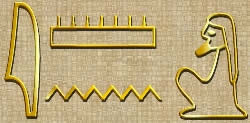 Amun
in hieroglyphs
Amun
in hieroglyphs
Notes
*1 Sobekkare-Sobekneferu
The last ruler of the 12th
Dynasty. She
reigned for three years and ten months. After her reign the
Two
Lands fell apart in the Second Intermediate Period and the Delta was
taken over by foreign princes, the hekau-khasut, or Hyksos.
Back to text
*2 Maatkare-Hatshepsut
Hatshepsut was the daughter of Thutmose
I by his
principal wife, and married to her half-brother Thutmose II.
He
died young and she was proclaimed regent for her infant stepson-nephew
Thutmose III. She made herself ruler, with young Thutmose as
her
junior partner. Her rule was peaceful and
prosperous. On
her death Thutmose III became sole King and expanded the Egyptian
empire as far as the Euphrates and the borders of Mitanni.
Back to text