Neferneferuaten:
Glorious is the Splendour
of the Sun
 By Robin Gordon
 Auksford 2024
©
Copyright
Robin Gordon, 2024
PART VII:
Auksford 2024
©
Copyright
Robin Gordon, 2024
PART VII:
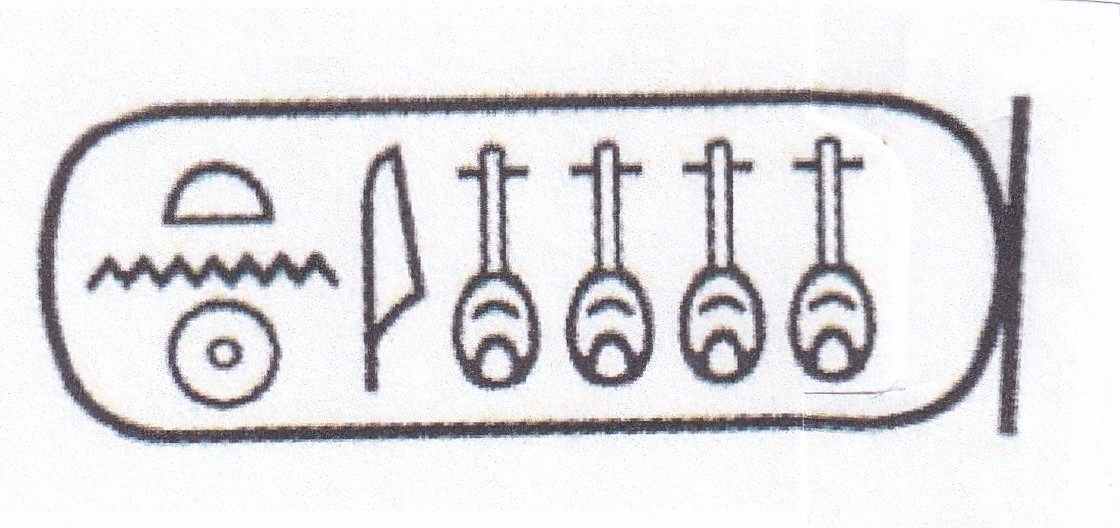
DJESERKHEPERURE-
SETEPENRE
 28.
Opet
28.
Opet
The time came for the great festival of Opet. Ay
and his
retinue arrived at the temple of Amun and were surprised to find
Horemheb there, with his retinue, and two royal carrying chairs.
“One chair for Your Gracious Majesty,”
said the First
Prophet, “and one for Your Majesty’s designated
heir.”
“Mnnngh!
This is a gr… a grand and
very appropriate way of
ensuring that the succession is unproblematic,” said
Ay. He
should never have agreed to make Horemheb his heir, he
thought.
As King he was assured of eternal life in the Field of Reeds.
His
hand had never been raised against anyone, as the gods must surely
appreciate. He could have found someone more to his liking to
succeed him as King. Now the First Prophet had taken charge,
and
it was going to be difficult for him to prevent Horemheb taking the
throne … unless he could find someone to arrange an
accident. He sniggered quietly.
The First Prophet oversaw the ceremony. He had
chosen that
the procession should travel by boat both to the Temple of Mut at
Ipet-resyt and back to the Temple of Amun at Ipet-sut instead of
following the processional way lined by statues of ram-headed lions,
the shesep-ankh,
established
by Maatkare and continued by King Nebmaatre, who had also transformed
the previously shabby Temple of Amun into a glorious sandstone palace
fitting for the King of the Gods. The boats were already
filled
with their passengers, the Prophets of Amun, (apart from the First),
the Greatest of Seers and the other priests of the Sun-God Re, the
priests of Hor, Sobek, Djehuty, Iset, Usír, Hwt-Hor, Khnum
and
others. Musicians and singers occupied other boats, and the
viziers, senior officials and senior army officers still
others.
Ay had never seen so great an assembly for the Opet Festival.
He took his seat in his carrying chair, scowling as he saw
Horemheb sit in the other, then they were carried in procession to
their boats together with the statue of the god Amun concealed in his
barque. Amun and the First Prophet then joined the
other
priests of Amun.
The trumpeters blew a stirring trumpet call and the boats
cast
off to make their way upstream to Ipet-resyt. The boat of the
trumpeters led the way, followed by the Songstresses of Amun, singing
and each playing a harp, a sekhem
or a shesheshet.
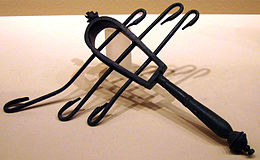
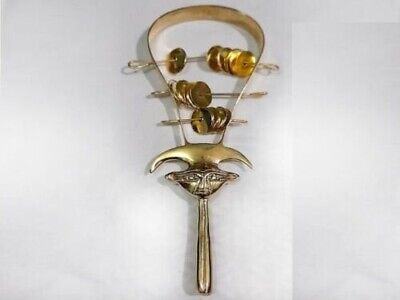
Sekkem
and Sesheshet
Then came the ship carrying the barque of Amun, surrounded and guarded
by his priests and followed by another boat of his
Songstresses.
After that came King Kheperkheperure-Irimaat Itinetjer-Ay with his
retinue, and following him came General Horemheb accompanied by his
ally Paramessu and Paramessu’s son, Seti, and their
retinue. The viziers and senior officials came next, then
came
the boats containing the priests of other gods, followed by boats of
songstresses, and finally officers of the army selected by General
Paramessu. The gentle wind propelled the whole fleet quietly
upstream towards the Temple of Mut.
On arrival the whole procession disembarked, but only the priests of
Amun entered the Temple of Mut, bearing with them Amun himself, still
concealed in his sacred barque. Ay and Horemheb, carried in
their
chairs, waited in the court, each surrounded by his own
retinue.
At length a priest appeared at the door of the closed sanctuary and
indicated that Ay should enter. The High Priest of Hor then
stepped forward and called in a loud voice, “Oh mighty Amun,
King
of the Gods, Hor of Hansu leads before you his beloved servant and son,
Horemheb, Hereditary Prince of the Two Lands, and begs you to receive
him.”
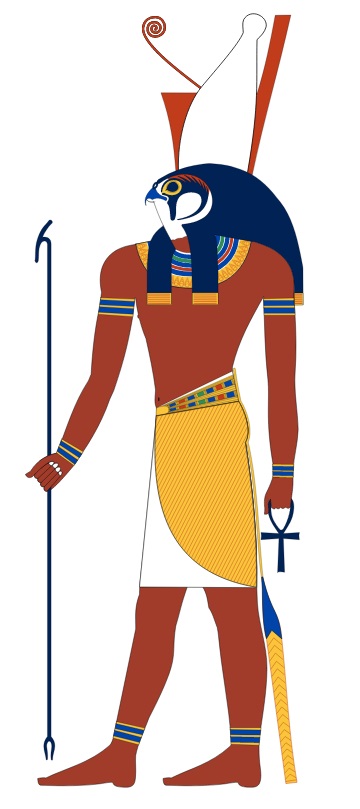 Hor
Hor
The
First Prophet appeared in the doorway.
“Amun
will gladly now receive Horemheb, beloved of Hor,” he said,
and Horemheb entered the sanctuary.
Exactly
what
happened in there was known only to the priests and the two
supplicants. It is believed that Amun re-enacted his first
coupling with Mut, wherefrom was born his son Khonsu, and thereby
ensured the continued fertility of Kemet and the strength and virility
of her King.
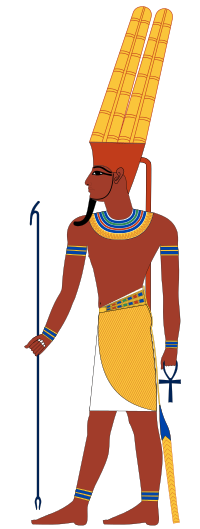 Amun
Amun
Ay was then taken into a side room, washed and shaved, anointed with
unguents, some perfumed with the blue lotus, and dressed in a new white
linen kilt. As he returned to the main temple he was annoyed
to
find himself seated alongside Horemheb, also wearing a new white linen
kilt and smelling of the precious perfume of the sacred lotus flower.
“The
kau
of our Kings are reborn,” said the First Prophet.
“Amun has lain again with Mut. Our Kings are
recreated,
Khnum has made anew their kau, and the Two Lands are filled with life,
prosperity and health.”
Again Ay and Horemheb were led into the innermost sanctum of Amun by
the First, Second and Third Prophets, for the eyes of the Kings and the
most senior priests alone might look upon the god himself, no longer
concealed within his sacred barque.
“Before the King of the Gods,” said the First
Prophet, we
now re-enact the crowning of the King of the Two Lands, chosen and
upheld by Amun himself.”
The
Second Prophet handed him the White Crown of Upper Kemet, Hedjet,
and he placed it on the head of Ay, asking if he would rule with
justice. Ay promised, using the ancient formulae, handed down
from generation to generation. Then he took off the crown and
handed it to the Third Prophet. To his surprise, instead of
laying it in the gilded casket, the Third Prophet passed it to the
Second. He handed it to the First, and he placed it on the
head
of Horemheb, hailing him as Kanakht
Sepedkheru (Strong Bull whose Plans are Effective).
 Hedjet
The Red Crown, Deshret,
was then placed on Ay’s head. He again promised to
rule
with justice, and, to his fury saw it placed on the head of Horemheb,
hailed now as Werbiawet-em-Ipetsut
(He who is Great of Miracles in Ipet-sut), and he heard Horemheb make
the same declaration.
 Deshret
Next came the Sekhemti,
the Double Crown of the Two Lands, when Horemheb was hailed as Heruhermaat Sekherpertawy
(He is Satisfied by Justice and He brings the Two Lands into
Existence). Then came the Atef-crown, with
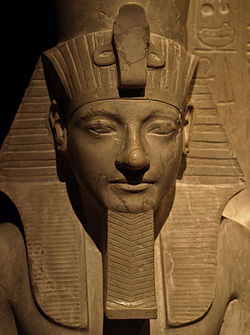
Horemheb hailed as Djeserkheperure-Setepenre
(Holy are the Manifestations of Re, the Chosen One of Re), and finally
the Khepresh,
the Blue or War Crown, when Horemheb was hailed as Horemheb Meryamun
(Horemheb, Beloved of Amun).
Whether Ay liked it or not, Horemheb was now confirmed by Amun himself,
King of the Gods, as King of Kemet, and now that the ever-loyal and
rather stupid Nakhtmin was gone, Ay would find it very difficult to
find anyone willing to murder an anointed and crowned God-King of the
Two Lands, no matter what he promised. There was nothing left
for
him to do but to make himself as comfortable as he could for his
remaining days, concentrate on his tomb, and try to persuade the gods
that his heart was free of the burden of guilt and lighter than the
Feather of Maat.
“How could the gods possibly
have chosen Horemheb,” he complained to the Greatest of
Seers. “He took our beloved Tutankhamun to war and murdered
him.”
“I think you’ll find,” the priest
replied,
“that it was Nakhtmin who murdered the King. He was
alone
with the King when he was killed, and witnesses have come forward who
say they saw the murder.”
“Nnngh!
I find it
hard to
believe, but if it is true,
Nakhtmin must have been working for
Horemheb.”
“The gods will know who is guilty,” said the
Greatest of Seers. “Even
if, for reasons beyond our human knowledge, they choose to make the
guilty one King, yet when he comes before Usír, his heart
will
be so heavy with guilt that he will be condemned. His heart
will
be thrown to Ammut, the Devourer, and he will be utterly
destroyed. That may perhaps be a comfort to Your
Majesty.”
“Mmmnnnghh,
y…yes.”
It certainly was not, for Ay was well aware who had plotted the demise
of Tutankhamun. As his death approached he sought reassurance
from the First prophet of Amun, and was assured again that the man who
had instructed Nakhtmin to kill the King would be judged and condemned
before Usír.
“So,
even if the person behind
the murder becomes King,
nnngh-nnngh-nnngh, there can be no way for him to escape
his fate?”
“No way, at all, Your Majesty. All the priests of
all the
gods are agreed. As soon as the murderer comes before
Usír
he is doomed to inevitable destruction.”
“Mmmnnngh-nnngh-nnnngh!
Good,” said Ay, but good was the last thing he thought this
unanimous view was. As his death drew nearer he grew more and
more anxious, more and more afraid, and as his terror increased it
undermined his health and brought his death ever closer. He
slept
badly. He awoke from vivid nightmares of Ammut the Devourer
seizing his heart while Horemheb stood by and laughed. When
at
last he knew he was dying it was in the miserable knowledge that he
would not travel with the Sun-God in his barque, that he would not
relax in the Field of Reeds and play Senet with Tey while his shabtis
performed all necessary labours for him, that Usír would not
welcome him into the Afterlife to live forever, that his heart, heavy
with the guilt of murder, would be cast to Ammut and devoured, and his
existence would end.
So it was that Pharaoh Kheperkheperure-Irimaat Itnetjer-Ay, whose
chosen names proclaimed that the Manifestations of Re were Eternal, and
that he himself was the Doer of Right, the self-styled God’s
Father Ay, died in misery and terror, knowing the fate he had earned.
The usual seventy days of mourning were proclaimed, his body was
mummified in the traditional way, without shortcuts, treasure was
placed in his tomb, his body was taken to its resting place, the tomb
originally made for Tutankhamun, on a sledge dragged by viziers and
other high officials, and there Horemheb, his designated successor,
performed the Ceremony of the Opening of the Mouth.
The tomb was sealed and the mourners ate the funeral meal together, and
there Horemheb remarked to Maya, “When the time is ripe
I’ll have him out of that tomb, and Tutankhamun will take
possession of it, near to his grandfather – and as our
beloved
young King wanted, I’ll have side-rooms made for his parents
and
his grandmother. Ay will be obliterated from our
history.”
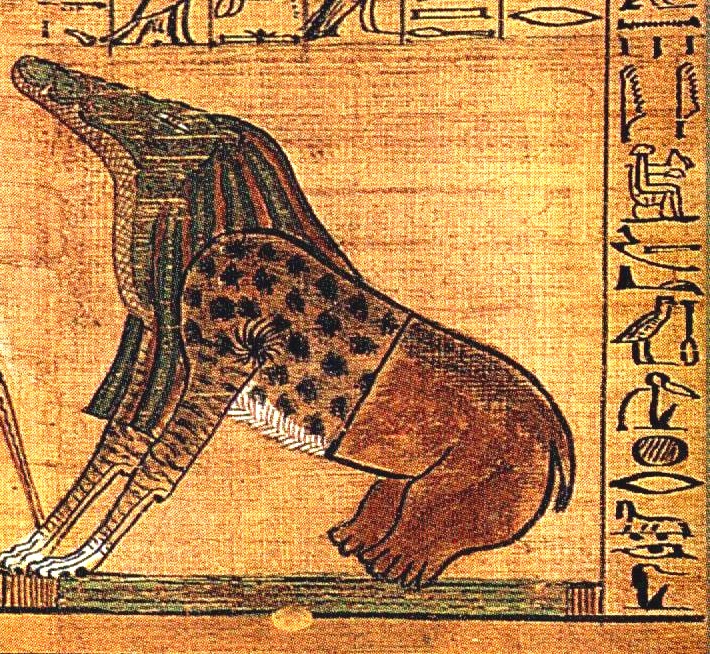
Ammut the
Devourer