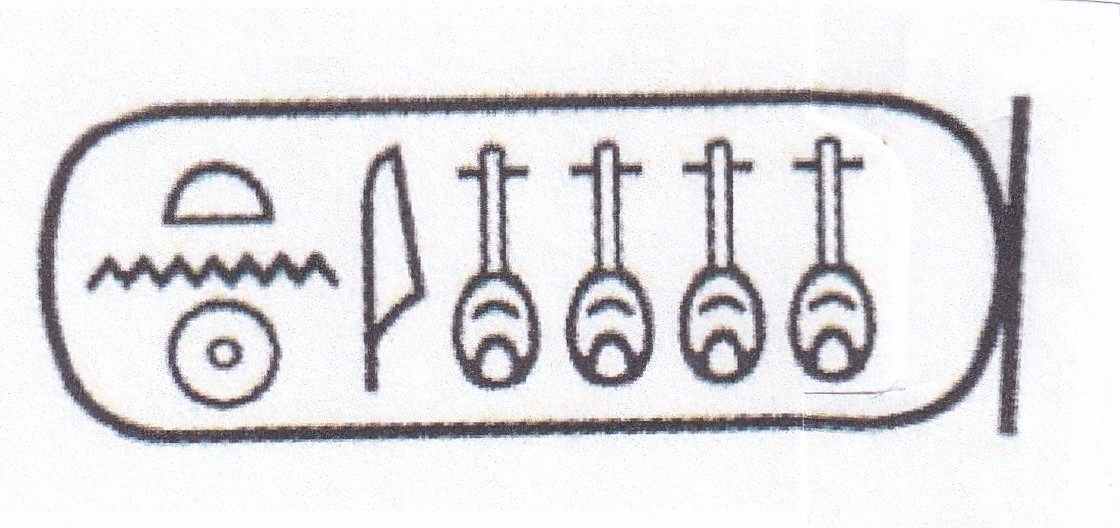
Neferneferuaten:
Glorious is the Splendour
of the Sun
 By Robin Gordon
 Auksford 2024
©
Copyright
Robin Gordon, 2024
PART
I:
Auksford 2024
©
Copyright
Robin Gordon, 2024
PART
I:
THE GODS OF KEMET
1. Creation*1
Behold,
the first of times and all the land
was
under water, nothing was above.
The
water covered all the world entire.
No
stars were there, no air, no wind, no fire.
No
living creature walked, felt hate or love.
The
water stretched forever on each hand.
By
magic cast by Re, eternal god,
the
Self-Created One, by him alone,
upon
the water’s surface there appeared,
called
forth by Re, above the waves there reared
a
water-lily, blue, and in that throne
came
into life the world’s first hexapod.
It’s
known by all: the scarab beetle’s born
throughout
the world within a ball of dung
without
the need that parents give it birth,
so
Re chose first that form to come to earth,
as
Khepri, who propels the Sun when young
into
the sky to herald early morn.
Then
the ka of
Re, his spirit, came
and
entered Khepri, who became a baby,
and
rapidly the infant grew: a man
stood
in the lotus flower and began
creation’s
work: he called forth all that may be,
and
Re became P’tah to start his game.
He
called a solid rock up from the deep.
Square
it was, and at its top a point.
The
Benben Stone it was, and from that hour
time
began, for Re now left the flower,
and
as he left with perfume did anoint
the
lotus. Scent of godhead did it keep
forever.
Re now stood upon the rock,
the
powerful god who moves the midday sun,
and
changed himself into Atum who sends
the
sun down through the evening sky and ends
each
day when through the sky the sun has run
its
course, and in his hand he took his cock.
Atum
now rubbed it and called forth his seed
which
he within his godly hand then caught
and
let it penetrate within his skin,
and
once the seed had found its way within
the
god was fecund swift as thought,
and
from his mouth he spat a noble breed.
Two
gods came forth, first Shu, the Lord of Light
and
Air, then Lady Tefnut came to birth.
These
two embraced and swiftly copulated.
Two
further gods were born when these two mated.
The
first of these was Geb the God of Earth,
the
second Nut, the Sky, and, as was right,
as
Re had ordered they should multiply,
they
fell into a passionate embrace,
and
Nut gave birth to four. First was Usír.
Then
after him came Set’kh, his compeer,
then
Nebet-het and Iset, fair of face.
These
Nine would rule as Highest of the High.*2
Then
Re said unto Shu, “Please separate
your
daughter and your son, for now they lie
in
close embrace. No more shall come to birth
till
Geb shall stretch himself and form the Earth,
and
Nut, the Mother, rise to form the Sky,
for
from that day all gods and men shall date
the
world’s beginning and the start of life.
So
Shu, the God of Light and Air, arose
and
forced apart the goddess and her brother,
for
from Nut’s womb should never come another
save
Re himself, for now his path he chose:
by
day the sun, by night eternal strife.
Then
Re-Atum-P’tah called forth by name
the
other gods, then animals and birds,
the
insects, plants, the fish beneath the sea,
and
finally mankind he called to be,
to
worship him and honour all his words,
and
that is how the world and life became.
Then
Re-Atum-P’tah asked Khnum to make
upon
his potter’s wheel the ka or soul
of
every human child, for he decided
that
every man and woman be provided
with
body, life and spirit to be whole
and
in the Afterlife a place to take.
Thus
all was done according to his word.
The
seed of Re had brought the world to birth.
The
gods were born or all called forth by name.
Mankind
would praise the Sun-God, spread his fame
and
worship over Geb who formed the Earth,
as
would the beasts, all feathered, finned or furred.
Notes
*1 Creation
Egyptian mythology can be quite
complicated, largely
because different gods were credited with the creation in different
cities, and local gods assumed greater or lesser importance in the
unified pantheon according to the importance of their home cities.
Different Egyptian cities assigned the
act of
Creation to Re or to Atum or to Ptah. Our version makes the
creator god Re, but assumes that Atum and Ptah were aspects of Re, as
later Egyptian theology tended towards a form of polytheism in which
all the gods were thought of by the educated classes as aspects of
either Re or Amun, or indeed Amun-Re.
Many of the better-known gods are known
in modern
times by the Greek forms of their names. I have chosen to
create
forms that are closer to what is believed to be an approximation to the
Egyptian pronunciation. Osiris, for example is believed to
have
been written in hieroglyphs corresponding to Wsr (vowels not being
generally marked in Middle Eastern scripts), and Horus as Hrr, possibly
in imitation of the wings of a falcon.
Back to text
*2 These Nine
would rule
Re, Shu, Tefnut, Geb and Nut (the first
gods) are
known only by Egyptian names, but the gods of the next generation are
better known by their Greek names. The equivalents are:
Osiris
Usír
Isis
Iset
Seth (or
Set, or Sutekh)
Set’kh
Nephthys Nebet-het
Horus
Hor
Iset became the wife of Usír,
and their son was Hor. Nebet-het became the wife of
Set’kh.
Back to text